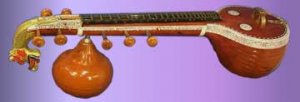
The Saraswati Veena is one of the most ancient and revered of South Indian instruments. Together with Bansuri flute this form of veena may be seen in many sacred pictures of Saraswati, goddess of musicThe Saraswati veena has an interesting construction. It has a body made of wood, generally, this is jackwood. The highest quality veenas have the entire body carved from a single block of wood, while the ordinary veenas have a body which is carved in three sections (resonator, neck and head). There are 24 frets made of brass bars set into wax. There is another resonator at the top of the neck of the veena. This is no longer a functioning resonator, but is mainly used as a stand to facilitate the positioning of the instrument when it is played. Because it is no longer functioning it is not unusual to find that this upper resonator may be made of acoustically neutral materials such as paper mache, cane or other similar materials.
Unlike north Indian instruments like the sitar, the Saraswati veena has no sympathetic strings. It has only four playing strings and three drone strings (thalam). The main bridge is a flat bar made of brass. This bar has a very slight curve. It is this light curve which gives the veena its characteristic sound. A major centre for the manufacture of the Saraswati veeni is in Tanjore
Features:
52" Long
24 brass frets
7 strings.
Painted and carved peg box.
With wooden shell case.
Most popular traditional Veena.
A fine quality instrument.